A 2-Month Summer Internship Opportunity!
- Internship
Description
- Schedule
and Curriculum
- Program
Sites - Internship
Application
GROW BIOINTENSIVE
2-Month Summer Internship
2013 Session
Applications for the 2013 intership are now being accepted:
The internship will start June 14, 2013 and end August 13, 2013
Application Deadline: EXTENDED to March 18, 2013
ABOUT THIS INTERNSHIP
Ecology Action will be offering a new two-month summer program that will teach small-scale, low input
farming methods. The program will take place at several locations in Northern California from
June 14th through August 13th. Program interns will learn practical skills that address issues of food
insecurity through a combination of hands-on fieldwork and classroom teaching. The techniques
taught will be a closed system, soil building, organic approach to food production. In addition interns
will learn about positive social solutions to food insecurity. The program will run simultaneously
with Ecology Action's 6-month intern program, hosting farmers and activists from the U.S. and
abroad, giving summer interns a chance to network with people interested in similar work.
Despite technological advances in agriculture there are still more than 1 billion malnourished people
in the world.1 Rising food prices have led to political unrest in many countries.2 In addition to the
social problems of our global food system, current farming practices are unsustainable. Conventional
agricultural techniques depend heavily on non-renewable resources, outside inputs from other soils,
and degrade farmable soil. The UN Food and Agriculture Organization has stated that the solution to
these problems can be found in small scale, localized, low-input agriculture:
"Global food production is more than enough to feed the global population, the problem is getting it
to the people who need it. In market-marginalized areas, organic farmers can increase food
production by managing local resources without having to rely on external inputs or food distribution
systems over which they have little control and/or access3."
Aware of the intensifying world challenges and the basic need of people to feed themselves, Ecology
Action has been working for over 40 years to develop an elegant, small-scale agricultural system.
This system, known as GROW BIOINTENSIVE, is a high-yielding, sustainable agricultural method
that emphasizes local food production and is based historically on intensive food raising systems.
Ecology Action has a network of affiliate organizations and former interns working around the world
to enable people to promote food security.
This two-month internship will be an opportunity to learn valuable techniques and information, to
experience an alternative living style, to make lifelong ties with other interns from different states
and countries. Interns will be assisting Ecology Action in accomplishing important work that can
help farmers, gardeners, and communities around the world to raise food, conserve resources and
build fertile soil sustainably. The program will be a combination of lectures, study, garden work, and
living the method. Once interns have completed their stay it is hoped they will engage in public
service for food security in community across the country and around the world.
INTERNSHIP EXPENSES
Applicants should note that this is an unpaid, fee-based internship program. Program interns will be
placed at four different project sites in Northern California. Housing /accommodations will be
provided at each site; however, other expenses will need to be provided by interns who are accepted to the program, as follows.
(Please
note that these internship fees are non-refundable)
Summer 2013 expenses include:
- Program tuition, $600;
- Field trips, $100;
- Textbooks and publications $125;
- Housing, energy and internet $450
- Food, $300; ;
- Incidental living expenses for the duration of the program $300.
TOTAL Due (Payable to Ecology Action, non-refundable): $1,875Not included in the expenses is personal travel to and from the internship site, which will vary per participant. All participants are responsible for any travel expenses associated with getting to and from this program.
Note*: From the funds deposited above, the intern will receive a check from Ecology Action for a certain amount of money at the beginning of each month of the internship program for his or her own food and incidentals expenses. Requiring interns to provide this money ahead of time guarantees the interns have funds to support themselves through the entire internship program. If you have questions about expenses please email contact@growbiointensive.org
To fill out an application for the internship, click here.
1 http://www.bbc.co.uk/news/science-environment-11503845
2 http://www.guardian.co.uk/environment/damian-carrington-blog/2011/aug/25/food-price-arab-middle-eastprotests,
http://www.voanews.com/english/news/middle-east/economy-and-business/2011-Food-Price-Spikes-
Helped-Trigger-Arab-Spring-135576278.html
3 United Nations Food and Agriculture Organization, http://www.fao.org/organicag/oa-faq/oa-faq7/en
Program Information
The two-month summer program will immerse participants in all aspects of biologically intensive
food raising. Interns will learn practical skills through their involvement in day-to-day farm work.
In the classroom they will learn about and discuss growing techniques and concepts, global and local
issues on food access and why our work is important. By the end of the program, interns will have
gained hands on experience and an understanding of the designing, planning and management of a
small-scale biologically intensive mini-farm. Interns will also have the opportunity to take field trips
to other Ecology Action project sites and local farms.
The GROW BIOINTENSIVE method focuses on using small-scale, organic, non-mechanized foodraising
techniques as a way of life. The work we do requires commitment, responsibility, patience,
attention to detail, willingness to follow detailed instructions, self-motivation, and mental and
physical stamina. While we do not wish to discourage those genuinely interested in the program, we
also want to make sure that applicants have an adventurous, hardy nature and can make a dedicated
commitment to the program for the duration of the internship.
The Internship will start on the 15th of June and will end on the 14th of August. Interns must arrive at
least 1 day in advance at each site to get settled and acquainted with the area.
Schedule and Routine
Interns will begin their day at 8:30-9am and end from 5:30 to 6:30pm depending on the site. Most days will be spent working in the garden. A typical day could involve preparing beds for planting, seed propagation, harvesting, taking and recording samples, transplanting, seed saving, and other garden tasks. At least one day a week and some times more will be spent in the classroom.
Classroom days will include lectures, discussions and multimedia covering a range of topics. Interns
will have readings and homework to complete each week.
At least one day a week will be spent inside the classroom. The interns will have weekly readings
and homework pertaining to the practical and conceptual aspects of GROW BIOINTENSIVE and
food security issues around the world. Interns will also work in the gardens of the respective sites
and should enjoy physical labor. At least one and a half days and as much as two days a week will
be free for personal time. The experience is demanding but rewarding to those willing to engage
themselves.
Note that Ecology Action is a non-profit organization focused on teaching motivated people about
the principles of small scale, sustainable food raising and community involvement. It is not a market
farm. If you are looking for experience in production and marketing on an organic farm, visit
WWOOF or ATTRA. Also, we appreciate that people who are interested in sustainable agriculture
are interested in exploring other methods. Please note though, that this internship will focus primarily
on the GROW BIOINTENSIVE method. For more information about this method click here.
Curriculum
During the course of the program the following topics will be covered:
The Theory and Principles of GROW
BIOINTENSIVE |
Social issues of small-scale farming and
food security: |
|
|
Interns will have several books and publications that they will use for readings and design projects. By the end of the program interns will have created their own design for a mini farm. They will also have the opportunity and help to formulate a project that seeks to meet a need in their community.
Follow-Up Activities
One of the unique aspects of this internship program is that we will allow you time throughout the summer to plan your next steps after the internship. It is expected that graduates of the internship program will be prepared to use their gained knowledge in some project within their home community, their school, or in some other way to help promote sustainable food raising. During the internship, participants will be able to work with a staff member to help plan and work through their future activities.
Program Sites
The program will take place at four different sites in Northern California. Each site is unique in climate, soil, living situation, and history. We cannot guarantee that you will be placed at your preferred site.

Ecology Action's Common Ground Research Garden (Willits, CA)
The setting at this site is rural and rustic. The Ecology Action mini-farm provides a demonstration of
what is possible when conditions are less than optimal. The one-third-acre mini-farm/garden is
located on a 20-acre site that offers a challenging soil situation on a mountainside slope. Basic fieldtesting
compares different cultivars, nutrient and compost amounts, crop spacing, and other practices.
Also, there are usually a variety of crops grown out to seed for Bountiful Gardens, our international
mail order company. The soil at this site is rated fair for grazing and has a level of magnesium,
nickel, and other minerals that would normally prevent the growing of crops. In addition, it has cool
nighttime temperatures and varied mini-climates within its growing area. GROW BIOINTENSIVE
practices are buffering these limitations, and food is being grown (although lower-than-normal
GROW BIOINTENSIVE yields were initially and are often still obtained). Ground was broken for
the Biointensive research garden in 1982. It took 14 years of soil improvement (from 1982 to 1995)
to develop a soil system that produces healthy plants and satisfactory yields at this location.
Golden Rule Community Garden (Willits, CA)
This training site is a joint program with the Christ Church of the Golden Rule Community just south
of Willits, CA and Ecology Action. The Golden Rule Community mini-farm/garden is located on
Ridgewood Ranch, a 5,000-acre home to the Golden Rule Community, a therapeutic riding program,
a large heard of free-range cattle, and acres of wilderness. The one-acre garden site has been
organically cultivated for over 30 years and in 2001 adopted the Biointensive methods of food
raising. Due to its location within a large alluvial flood plane, the garden contains fluffy, rich,
uniform soil on flat terrain that lead to good garden yields. While the climate provides slightly
warmer temperatures for growing throughout the day than our other Willits site, at night the cool air
settles in the valley creating a difficult temperature swing daily. Its main focus is on providing food
for the Golden Rule Community, growing an array of seeds for Bountiful Gardens, and training
interns and other visitors in Biointensive gardening. It also has the unique opportunity to focus on
low-tech alternative technology and processing within the garden and for cleaning seeds. The
Golden Rule mini-farm demonstrates what is possible using GROW BIOINTENSIVE under
reasonably good conditions and in the summer is a treat for anyone to see! It is beneficial for the
training of trainers and staff for projects focusing on production mini-farming and development minifarming
in this and other countries.

The Green Belt (Mendocino, CA)
The Greenbelt Program site in Mendocino, California is situated on the grounds of the Stanford Inn,
an eco-resort nestled on the cliffs overlooking the confluence of the Big River and the Pacific Ocean.
Our program is focused on: developing the GROW BIOINTENSIVE model for our coastal, cool,
foggy climate, improving the soil and teaching the GROW BIOINTENSIVE method. There are
many challenges at the site that create opportunities to demonstrate practical and effective ways of
maximizing resources and managing fertility. There is an inherently good soil here but it underwent
years of compaction as a horse paddock. We are working to build soil structure and fertility to restore
the soil health. We experiment with growing complete diets and different crop varieties to find which
are best suited to this unique growing climate. Our internships are unique and offer a great
experience in water conservation, soil fertility management and food raising through the GROW
BIOINTENSIVE method.
Common Ground (Palo Alto, CA)
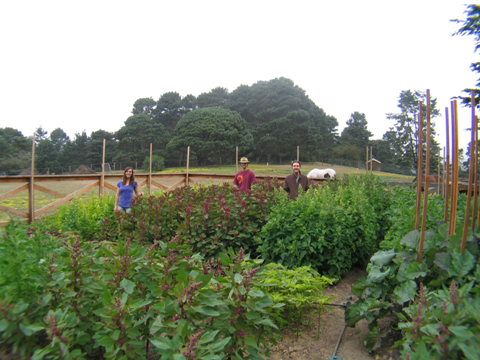
Located in Palo Alto, California, the Common Ground Garden is devoted to growing a GROW
BIOINTENSIVE mini-farm as an educational, community resource. The use of the half-acre-plus
site, of which only part is currently in crops, is donated to Ecology Action for the development of an
edible oasis in this asphalt-and-lawn friendly suburb. This site's main focus is to model a truly
sustainable food system for Bay Area Residents. This garden demonstrates to potential to grow both
a major amount of nutrition and calories within the confines of a suburban lot, showing people just
how much they can grow in their own backyards. We especially enjoy growing crops rarely seen
within city limits, such as wheat, barley, and flour corn, because they help our visitors make the
connection between the most ubiquitous parts of the American diet, and the land. We partner with
the Common Ground Organic Garden Supply and Education Center to bring classes to the
community as a whole, and we are developing programs to open the garden up to local schools for
their use as a living classroom. Our internship is an immersive experience in growing both soil and
community through the GB method..
2-Month Internship Application
Your internship application must be sent by the EXTENDED application deadline of March 18, 2013, but participants are encouraged to apply as early as possible.
Space is limited. The Ecology Action staff will select applicants on the basis of the impact their work is likely to have in the future; priority will be given to those with a goal of using GROW BIOINTENSIVE Mini-Farming practices in outreach and public service projects.
Applicants should note that this is an unpaid, fee-based internship program. Program interns will be placed at four different project sites in Northern California. Housing /accommodations will be provided at each site; however, other expenses will need to be provided by intern, as follows. (Please note that these internship fees are non-refundable)
To Apply:
- Download and read the 2-Month Internship Information Packet
- Complete the Online Internship Application Form (our secure online registration form, hosted by FormSpring will open in a new window).
- Once you are accepted, pay for tuition and fees. The decision date for this internship is April 1, 2013. You will be notified whether you have been accepted, and if you have, you will be provided with further information on how to proceed.
Summer 2013 expenses include:
- Program tuition, $600;
- Field trips, $100;
- Textbooks and publications $125;
- Housing, energy and internet $450
- Food, $300; ;
- Incidental living expenses for the duration of the program $300.
TOTAL Due (Payable to Ecology Action, non-refundable): $1,875Not included in the expenses is personal travel to and from the internship site, which will vary per participant. All participants are responsible for any travel expenses associated with getting to and from this program.
Note*: From the funds deposited above, the intern will receive a check from Ecology Action for a certain amount of money at the beginning of each month of the internship program for his or her own food and incidentals expenses. Requiring interns to provide this money ahead of time guarantees the interns have funds to support themselves through the entire internship program. If you have questions about expenses please email contact@growbiointensive.org